Brazilian Race Clubbers, Fabiola Molina and Henrique Barbosa posted some fast times on the final day of the Maria Lenk Brazilian Trials: Molina set a meet record for the 100 backstroke (1:01.95) while Barbosa took over the 100 breastroke (1:00.92)! 5.11.2008
click here to read article
meet results here

Fabiola Molina grabbed a meet record in the 50 backstroke at the Maria Lenk Brazilian Trials in Rio De Janeiro (28.71)! 5.08.2008
click here to read article

Mirna Jukic set a new Austrian national record in the 200 IM finishing in 2:15.35 at the Austria Meeting in Vienna! 4.27.2008
click here to read article


Rafed El-Masri finished second at Germany's Olympic Trials in the LCM 50 fr touching in at 22.26! 4.22.2008
click here to read article

The Race Club's Nathan Adrian took the world title in the 100 free with a meet record of 46.67 at the FINA World Short-Course Championships!
click here to read article


World Team members Duje Draganja and Mark Foster took 1, 2 in the SC meters 50 freestyle Friday in Manchester, England. Draganja clocked in 20.81 setting a NEW WORLD RECORD! 4.11.2008
click here to read article

World Team member Nathan Adrian with teammates Ryan Lochte and Bryan Lundquist (Doug Van Wie not pictured) after breaking the world record in the SC meters 4x100 Free Relay at World Championships in Manchester, England. 4.09.2008
click here to read article


members of the World Team at Founders Park in Islamorada, FL


Gary Hall Jr. and Mike Cavic with their 15 lb Mutton Snapper

Congratulations to Mike and Gary for spearing a huge 15 lb. Mutton Snapper, setting a new TRC Boat Record! Check out Gary's fish story here... 4.21.2008


Swimming on the Freeway

By Gary Hall Sr.

In the first fundamental rule of fast swimming, we learned that though we are shaped more like bricks than fish, the little things we can do to make us behave more like fish (keep our heads down and body aligned, streamline off walls and starts, wearing new technology suits) make a big difference in our speed, even with the same or less amount of energy expended. Now let’s focus on the second fundamental rule of fast swimming: swimming on the freeway.

Most people (even kids that don’t yet drive) understand that cars get better gas mileage on the freeway than they do around town. We hear it a lot lately, particularly with skyrocketing gas prices. But it is surprising how few people understand why. Doesn’t it seem a bit odd that we can get better gas mileage driving 65 miles per hour on the highway than we can, averaging 35 miles per hour in town? Well, any swimmer who has miscalculated the wall on a flip turn and who has extended their legs fully with a mighty force, only to discover nothing but water was there to await their feet, should know exactly why. There are few worse feelings than having to try to build up to race speed from a virtual dead stop. It is bad enough to watch all of your competitors zoom by you with their spring off the wall, but to top it off, now you have to spend soooo much energy getting going again that, well,……there is always another race.

Gas mileage around town is bad because from a dead stop, it takes a great deal of energy (fuel) to get that heavy car going to a decent speed; even more than it takes to keep it going at a higher speed (called inertia). The same is true in swimming.

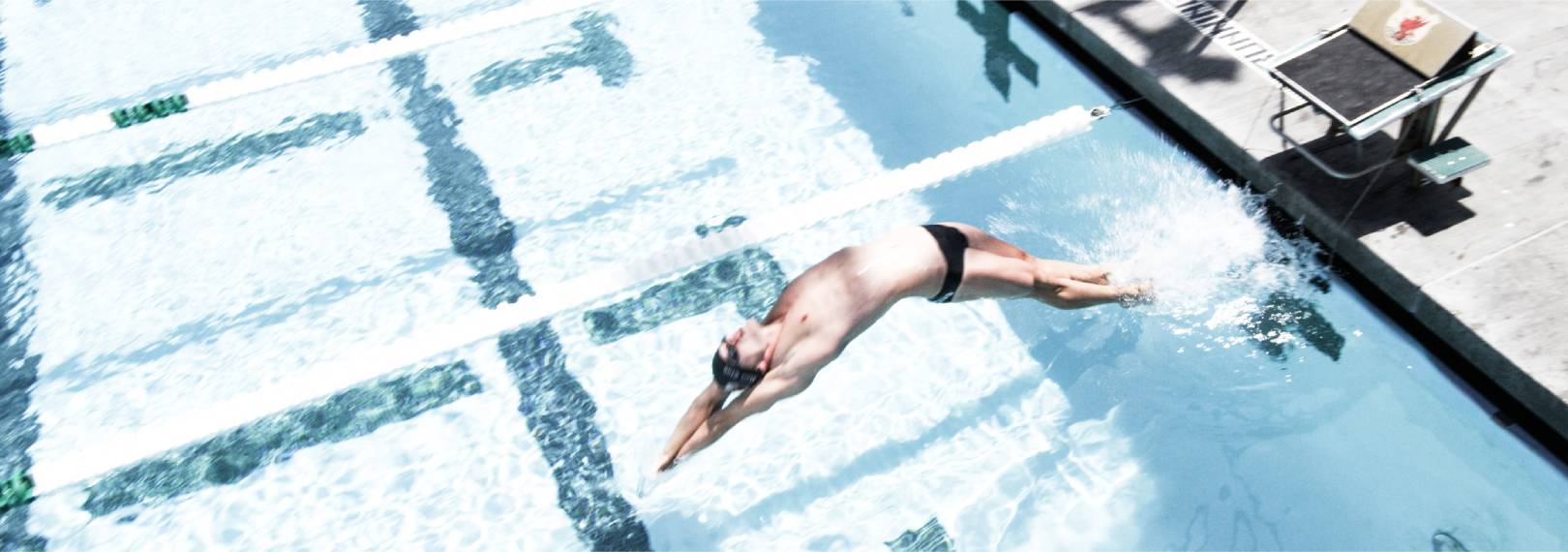
Remember when I told you that when you dive into the water from a starting block for a split second you are going around 5 miles per hour. Yet, in just 5 seconds (without the help of a kick or pull out), you come to a virtual stop. That means every second in the water from the time you entered you slowed (decelerated) around 1 mile per hour each second. Or in a half a second you slowed ½ mile per hour and so on. The point is that we slow down very quickly, unless we do something to maintain our speed. Before we can talk about maintaining our speed in swimming, however, we must first understand where the speed comes from.

Although exactly where the most propulsive power (the power that moves us forward) is generated in swimming has never been proven, it is my belief that it comes from the arms at the beginning of the stroke; what Mike Bottom calls ‘shoulder driven’ freestyle. Less comes from the arm pull in the middle of the stroke and even less from the end of the stroke. The legs contribute to both lift and propulsion (as do the arms) but contribute less to propulsion than our arms at the beginning of the arm stroke. So if you believe what I have said about the propulsion, then the arm pull, shortly after the hand catch is made under water, shall be called the power position. Again, it is not that we don’t generate power from the other hand positions or legs, it is just not as much.

So since we know that swimming on the freeway is much more efficient than swimming around town, how do we stay on the freeway? In other words, how do we maintain our speed and not slow down and speed up, then slow down and speed up again? The answer is to keep one hand in the power position all the time.

The problem with this solution is that we only have two hands. Since it takes some period of time to get the hand from the end of the stroke back to the beginning (the power position), there is always some lapse of time between the time one hand leaves the power position and the time the other one arrives. Ideally, if we had three hands and arms, we would always have one hand in the power position at all times. We’d be riding on the highway. Since we only have two, we must not waste any time getting our hand back into the power position.

For every second, or half second or tenth of a second it takes us to get at least one hand into the power position, we begin to slow down. Maybe not a lot, as we still have our kick and some propulsion from the end of our arm stroke going, but nonetheless, we begin to slow down and sink. The less we slow down (ie the less time lapsed in getting back into the power position) the less energy we need to expend to get the speed back. The more we slow down (ie the longer the time to get back into the power position) the more energy required. In the former, we are swimming on the freeway. In the latter, we are swimming in stop and go traffic. Where would you rather be?

Getting your hand back into the power position quickly requires effort. Remember, the fundamentals to swim fast don’t make swimming easier. They just allow you to swim faster. The Race Club swimmers spend a great deal of time on boxing drills to practice getting their hands back into power position as fast as possible. Whether you use straight arm or bent arm recovery, the recovery should be fast and come over the top with the hand in position for an immediate catch or hold on the water. I also think it is important to release the hand sooner than most of us do. Too many swimmers focus on pushing their hand back at the end of the stroke, which just delays getting it back to the power position.

For freestyle, one of the best drills I know to get the arms recovering quickly is the freestyle pull with dolphin kick. One arm stroke for each dolphin kick will force your tempo and stroke rate up higher than you are used to. It forces you to swim on the freeway. Try it, but don’t slow your kick down. Speed up your recovery to keep up with your legs, but use one stroke per one kick. Once you have the tempo right, switch back to flutter kick with the same tempo.

In backstroke, you can try the same drill, or if that feels too awkward, try what I call the “half-stroke backstroke”. What I mean by this is just take the top half of the arm stroke, not the second half. In reality, you won’t be able to do it. But psychologically, it will force you to release your hand early and get it back over your head into the power position (which by the way in backstroke is also at the beginning of the arm pull). So imagine you are only taking the top half of the stroke and you will get on the freeway.

So now you have learned the second fundamental rule of fast swimming. To keep on the freeway and not swim stop-and-go, you must keep the hand over your head in the power position as long as possible and get your other hand back there as quickly as possible.

Next, we will talk about the third fundamental of fast swimming: swimming with your body. Of the three, this is the most difficult to teach, requires the most concerted effort and yet, likely will contribute the most to your added speed. Stay tuned.


The World Team
Our Swim Camp Coaches and Athletes
Gary Hall Jr. - Race Club Swim Camp Trainer and Olympic Swimmer
Gary Hall, Jr.
World record swimmer and ten time Olympic medal winner.


Mike Bottom
World's greatest sprint coach and coach of The World Team.


Matt Macedo
20-time All-American swimmer at Cal under Mike Bottom.


Mark Hill
Head Coach of the Florida Key’s Swim Club and technique Coach for The Race Club swim camps.


Gary Hall, Sr.
Competed in three different Olympiads (1968, 1972, and 1976).


Our Partners